Tuesday, June 28, 2016

Arrogance, narcissism and changing the world

One of the primary goals of this blog, as said in the opening post that no one read, is to dig deep into what I think and genuinely present it to you, so you can all laugh about it. One of those things floating around the empty space between my ears is the urge to leave the world behind me in a better condition with respect to the one where I found it. I choose this as the first introspective topic because not only is the only thing that matter, but also because in one way or another is the driving force of almost everyone in doing everything.

So far the expression leaving a better world is just acknowledging the fact that, with the exception of those that just like to see the world burn, we all have good motivations to do what we do and with this mild definition every little action has some reason we believe appropriate, founded on some moral value or some necessity. Therefore, the topic is so generic that is including insignificant actions or thoughts, even those we don't like (like do some shitty job because in that moment is the only option).

So let me try to be more specific. I want to explore those actions that are targeting the behaviour of someone else too. It can be to educate your kid to behave in the right way, or fight against global warming by not owning a car, or not eat meat because you hate your life, or tell people to vote for one candidate.

Or spending your time to write for strangers so they can feel something while reading.

Then there are the obvious one, like doctors, firefighters etc. They are amazing, so we don't care about them here.

All these actions are founded in a never confessed arrogance that everyone has (and should have). The arrogance of thinking that our way is the right way. There can be several different reasons why we believe that: statistical evidence, experience, scientific studies, religious beliefs, superstition, education received, etc. This is such a good set of reasons that makes very hard to see the arrogance in ourselves since it lives in the obvious conviction that my reasons are better than yours. One may or may not prove that one reason is better than the other, but will inevitably fall in the assumption that the interlocutor is sharing the same scale of values, the same education. By being convinced that we are reasonable people, we often forget how unreasonable we may look from the outside.

So for example, I may have (actually I do) solid arguments in favor of building a society more founded on a scientific approach to common problems, supported by a strong challenging scientific education since the very early stages of our life. Some of you may completely or partially agree with me. However, the question is: how effective can my words be for a religious fanatic? Especially when I identify my interlocutor as a fanatic.

Since nowadays the popular culture is founded on TV shows, for the next step I recall a scene in Aaron Sorkin's (praise the lord) The Newsroom. Sloan Sabbith, the expert economist of the show, wants to quit also because in months of hard good work she didn't change the fact that 42% of American citizens were believing something wrong. I found that little piece of dialogue perfect, the character did her job, gave the example of a correct precise worker and she changed nothing. 

On a more real example, in his famous piece John Oliver, to use a vocabulary that works on the internet, destroyed, eviscerated Donald Trump. His voice sounded loudly from his show (that is similar to what The Newsroom presented, sometimes literally) and his YouTube channel to the collective mind of American voters. However, we all know that eventually Trump won the primary election and still has a fair shot for the American presidency.

Why? Both the fictional and the real characters were just trying to make the world a better place, why didn't they sort any effect?

(Yes, I know, I used two HBO's shows as examples and HBO is not that popular, being quite expensive, I am trying to make a point, shut up)

I think the all point is that you will never give sense to a senseless mind. Sloan can't teach to people that think they can't learn, as well as to people that have no reason to believe they are wrong on a notion. John Oliver can make a piece that is a beautiful example of journalism and comic ability, but will never convince a Trump's supporter that Trump is bad. It is basically trying to communicate in different languages.

Trump's supporters will never see what John Oliver wants to communicate, because it attacks the foundations of their belief with a language that in their mind is saying here comes another TV star that wants to make money by pissing on Trump and on America and who the fuck is John Oliver btw.

Terrorists, in a sense, do the same. They believe in something and believe that some action is the right thing to do to achieve what they want. They even succeed in the action, but they always fail in the goal. They don't understand that the method is not going to change anyone else's mind.

In other words, people generically see what they want and what they expect to see. We expect the opposing team to do something and, as soon as our prediction is even partially fulfilled, we shut down our ability to understand what doesn't belong to us. Surprisingly enough, we don't apply the same method when we want to communicate. We are often so concern to be right that we forget the fact that being right about something is pretty much pointless if we don't change what surrounds us. If those that are trying to make the world a better place (pretty much everyone) do not start to understand who doesn't think like them, every action will always be only a narcissistic exercise of a non-provable superiority.

Don't get me wrong, I'm ok with it. Narcissism is what is keeping this society, with less and less human interaction, together. It is the reason behind our Facebook statuses, the politicians' words after some tragedy and, of course, these very pages (and this post in particular). Without narcissism (as well as without arrogance) we would lose a big part of our humanity. I'm not sure if it is a bad thing, but I see that as a probable outcome.

The take home message of this arrogant and narcissistic post is that to live in a better world we should try to really understand what doesn't sound good, what is in conflict with our beliefs and what is speaking a language different than ours. Probably, the way to achieve that is to begin with a very skeptical look at ourselves, because accepting and understanding our own human nature is a necessary step to start convincing other people of whatever bullshit is floating in our mind.

Monday, June 27, 2016

Game of Thrones, is it time to give up?

I'm not sure how to begin a post like that, so I start with a little story. (Useful to make everyone leave before encountering any spoiler because there will be many).

When I started watching The Walking Dead, I was very happy. It was perfect: mystery, tension, fear, uncertain fate for the main characters, violence and zombies, tons of zombies. The first two seasons were everything a TV show should be, a plot that was pure entertainment. Then, slowly but inexorably, events stopped happening, the tension was confined in the last few minutes of every episode just to make us junkie come back the next week, the plot was less and less important and even the zombies were not around anymore. The drop in quality was very subtle, nobody really noticed it, but eventually more and more viewers were just falling asleep at every given episode. I always wondered if it was me or the show that changed, TWD is the first TV series that I have abandoned and proved me that there is nothing bad with that.

All of that to say that if GoT season 5 was disappointing for me under many aspects, the just-finished season 6 not only confirmed the trend, but also added several annoying new features. Like in the other review, a disclaimer before continue: I know, the books are different, I know, the books are better, I don't care, books are always better because they obey to different rules.

This season managed to pass from episodes where nothing was happening, literally wasting screen time with irrelevant facts and shorter episodes, to compressed, unnatural, developments. The plot was always without any tension, the viewer knew at any given moment what was going to happen next.

I have to give credit for a few great scenes, but I feel something is lost, the situations are not built as in the past. The show rushed from one side of Westeros to the other, trying to show us what was happening to everyone. The only problem is that, most of the times, nothing was happening. What is the purpose of showing us Dorne if none of them will ever play a role again? Why do we have to hear 5 identical speeches from Danaerys? Why showing us Margaery plotting something if after all she just drew a rose on a piece of paper? And most of all, do we really need to see the damn High Sparrow in every episode? He doesn't say anything interesting and, for those that think that his dialogues are cool, remember Littlefinger and Varys, there is where I set the bar.

Even when they do things well, everything looks sloppier. The death of Hodor was an emotionally devastating moment, perfectly presented, like the good old days of the Red Wedding. D&D just decided to completely leave that story line for 5 episodes (half of the season), until in like 3 minutes they foreshadowed the destruction of the Wall (no deaths until the Wall stands) and revealed the most anticipated revelation ever. Come on, I live under a rock and I knew the origin of Jon Snow.

The battle of the bastards is a masterpiece, probably the best shot battle of the series, miles and miles ahead of anything else seen in this genre. However, besides the technical perfection, it starts with Rickon's death (and nobody gives two shits about him, we barely seen him, he did nothing, he tried to do nothing, he is even more irrelevant than Tommen), it continues with an emphatic charge of Jon (and we all know that nothing bad is going to happen him) and when everything is going bad again Littlefinger saves the day (as we all knew). 

Everything Arya does is super cool, but they show her only a few minutes every now and then. Eventually they tried to build up a tension on her fate, with a cliffhanger of her wounded at the end of one episode. The result was bad, because when you waste time in stupid cock jokes, then you have to rush the events. So not only everyone knew that Arya was going to survive (because otherwise what's the point of living in the first place) but also seeing her succeed was unrealistic and, generically, flat. Like a low-quality blockbuster movie.  

It is sad that many good characters were simply left behind. Littlefinger was one of the most promising one, his schemes, his political skill and his ambition were presented dialogue after dialogue, one fake smile after the other. His dark deepness was a driving force of the show (literally, since almost everything is happening because of him), so having him on screen for few minutes only when the plot demands it and with no explanation is a pity. If you then consider that his screen time is stolen by the most boring king in history of kings, manipulated by his wife (and we were left hanging for 4 episodes in that case too, I have almost forgot her existence, and guess what? nothing happened, she had no plan) and by the pointless religious fanatic, you start realizing that this show went down the hill too much.

Every evidence is showing that, although still enjoyable from time to time, the show is getting worse and worse at every new season. I can understand that for budget reasons you can be cheaper in some scene, but the poor writing and the bad choices are inexcusable. The more I think about it, the more I'm afraid to admit that even the good episodes (like episode 9 and 10) are looking that way only because they let us starve, gasping for a good quality show, in the previous 3/4 weeks. Because let's face it, this season wasted almost 4 episodes in silly stuff and religious bullshit. And this, my friend, is The Walking Dead effect, lower the general quality in order to make the ordinary sublime.

Therefore I was wondering: is it the case to let the show go? With every evidence pointing in the direction of a firm yes, it is also true that in the last good episode they got rid of the most annoying characters (basically everyone in King's Landing, the damn High Sparrow above all), that there is only one season left (but I fear the fact they will split it into two smaller seasons), and that I really want to see this winter everyone is talking about. 

Before writing this post, I watched again the first seasons of The Walking Dead, to find out who changed, me or the show.

The show. Hands down. 

TV writers are secretly organized to make us become addicted to their shows and then kill us with the filthy swipes of boredom.

When they will start to take over the world, remember: you read it here first. The future resistance, lead by Aaron Sorkin, has to know that they have to send a terminator back in time to save me, just in case. 

Tuesday, May 31, 2016

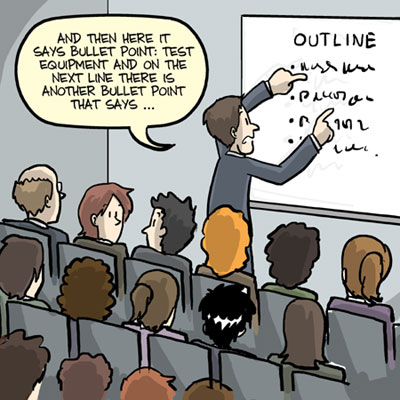
The nightmare of giving academic talks

A very common situation everyone has to face, especially in the early stages of the academic career, is to give a talk. It is a perfect experience for your social anxiety, it gives you the occasion to present yourself and your research, being the best chance to extend your professional network (and we've already discussed on how important this is). I don't need to go any further to explain why you want to do it right, even great.

I have no authority to give you any advice on this issue, although there are some general tips to keep in mind. (a very nice discussion on this topic can be found here, or, you know, google it)

The first thing to consider is the kind of audience you have to face. I'm personally not a fan of changing your scientific message too much for different audiences, but academia may require different levels of formality. The best tip on this matter, in my opinion, is to let your personality shine in any situation, a talk from someone feeling comfortable is much more enjoyable.   


Nobody, in principle, cares about your research as much as you do. Therefore, your first goal is to make the audience care, not to show them how good you are. First, if it's not clear why they should care about your obscure research, they will never fully appreciate the beauty of your methods or the elegance of your results. Secondly, and more importantly, a talk is not a lecture, you are not there to teach them how to do your job. It seems rather trivial, but it is not uncommon to find speakers that, being too focused on showing the details, completely miss the main message of their talks. It is also obvious that 99% of the audience will not probably understand your over-detailed presentation, although nobody usually admits that, scared to look stupid. If you want to give a great talk, you should attract the audience to your topic, drive them through the most basic steps till they care about your problems, show them your ideas, not your tedious technical steps. In this way you will achieve the real goal: make them feel smart as much as you (and more than you, they figure it out in less time than you).

All of this should be obtained by showing also your humble smartness. A piece of cake!

Assuming that you succeed in this extremely difficult task (especially the first 26 times), here come the questions from the audience. You can measure  the effectiveness of your talk from this moment. A good strategy is to design your speech in order to drive the attention to specific questions of your choice. In this way, you will look smart and prepared on your research, the audience will feel more involved in your scientific process and you will take out some time from the possible nasty question waiting for you in some dark alley.

To fully accomplish that beautiful scenario, you need to know some of the people in front of you. Maybe there is an expert in a different field, known to always ask something about his/her research at any given seminar. As I said, do not change your scientific message, but be prepared to that predictable question, it will show your interest to topics other than yours.

Sadly, not all the questions will be reasonable or come from an innocent voice. The tip that never failed so far is: never engage. 

There can be the one that wants to show off and not really ask questions, but rather talk for a minute about something. This person will probably look smart to everyone except to you, because if you are the speaker you can (and you have to, in order to not being intimidated) spot an idiot. But the rule is: never engage, just thank for the comment and move on. 

Occasionally, you may find one of those people that translate their smartness in being a flaming asshole. Those that will begin their question with a very polite I don't agree with everything you said or ask you to step way outside your comfort zone just to catch you off guard. Being an asshole to look smarter is sadly a common habit in academia, but you are even smarter and you remember the golden rule


If caught off guard, do not panic, discuss it during the coffee break
The reason is that, let's say 95% of the times, you are the only one with a microphone, the only one that everyone can hear (if so, remember also to repeat the questions, it gives you time to think and you let everyone participate). Moreover, flaming assholes are not there to discuss with you, they just want to climb the ladder by stepping on you. Therefore, if you engage a discussion with someone, you will most certainly look like a crazy person speaking to the wind about something that no one else could possibly be able to understand. 

Considering that there is a possibility that you looked exactly like that during your talk, it is better to give a different impression during the question time.

You always have to remember that you are there to speak to everyone, use your power (the microphone) to make that happen. You will give a better impression, you will keep full control of the situation and, if you don't know the answers, nobody will really hunt you down during the coffee break: it is the bloody coffee break, the only religion tolerated  in academia.

Friday, May 13, 2016

Jessica Jones, how a superhero can be extremely realistic

Jessica Jones is not a TV Series that will be remembered for too long, but this second Marvel+Netflix product gives us few reasons to spend the next 3 minutes to read about it.

We are in the same universe of Daredevil, taking place in the same city, right after the events of the first season, introducing also a couple of new characters that appear in season 2, as well as opening up the way to new shows that will be released by Netflix in the next months. Therefore, before focusing on this show, I have the chance to point out a good aspect of this new Netflix policy. They started with Daredevil (that is amazing), that has some common characters with Jessica Jones, that introduces few heroes and villains appearing in future shows. This is a smart move by itself to capture the fans and it is also executed in the best possible way. You can easily follow every single one of these shows separately, without losing any information vital to the plot (at worst you don't get some reference, but it really doesn't matter). The other analog that is coming to my mind is The Flash/Arrow/others universe, doing more or less the same thing, but in a bad way. In fact, if you don't see all the shows, you miss something in the plot, you lose some important information. Or also, to leave the superhero madness for a second, in the Chicago Fire+spinoffs production, it just happens that you miss important parts of the plot, understandable to attract viewers to the smaller shows, but sometimes you don't have the time for the smaller shows. You know, sometimes you see people and go places.

This huge amount of superheroes on TV and in the movies will be a reason for a future post as soon as I find something interesting to say about it.

Going on topic, Jessica Jones is a private investigator with superpowers and a huge drinking problem. She was traumatized by some mysterious event and she lives as an outcast, essentially being for some aspects a bad person. The style of the narration is very similar to the Daredevil's one, thus giving us a product of good quality, a nice plot and, most of all, a truly terrifying villain. 

One of the aspects that caught my attention is that, probably for the first time in recent years, the authors make us live the drama of the victim of a rape. The traumatizing event, that, besides the origin story, defines the essence of the main character, also involved rape. It is fully acknowledged by the victim, never by the rapist. I found this a very powerful message that was somehow lacking in other shows. For example, the rape of Sansa Stark in Game of Thrones has basically no consequences on the poor Sansa, while we move our attention to the drama that Theon Greyjoy is living for looking at that rape. It makes no sense on a human level. Here we are, as it should be, fully focused on Jessica's problem, on how her life changed for that event, her pain, her rage, her need to escape.

If on one side we have Jessica dealing with the consequences of her actions, on the other we have Kilgrave, the villain that never cared about them. He is very well constructed and presented, improving the show significantly. He is extremely scary for the entire season not only because his power, mind control, is so potentially devastating (and we see the effects on how broken Jessica is) but also because he is clearly a selfish spoiled prick. He is so human to be the perfect incarnation of evil. He acts only for his own interest, stepping on everyone else, killing everyone, ruining their lives. He also tries to justify himself with a horrible childhood, but it turns out it wasn't true that either (and it was brilliant). 

So far it seems a show that will be remembered, a great show, so here come the bad aspects of it. 

Starting from the end, the entire scene of Kilgrave's murder is absolutely underwhelming, the plot was clear since the very beginning, the scene has no tension at all. Although I appreciated the fact that Kilgrave, after being careful for 12 episodes and calling out Jessica's bluff, lowered his defenses to give up to his obsession (or, to say it better, to the realization of his obsession), they could have played that much better, considering the quality of the rest of the show. Also the fact that Jessica gets away with murder charges in like 3 minutes is way too rushed. In other words, they needed some extra time to make it right and the next point is where they could get it.

Agent Will Simmons is absolutely useless for the plot. He starts by being a random cop, victim of Kilgrave, then it turns out that is some super soldier on drugs, for no reasons at all he kills a detective (yes, there was a reason, but the transition is too damn fast), then he betrays his obscure organization in like 2 minutes and 10 minutes later he gets captured by them. The end. Yes, I know that he will be a villain in the Marvel universe and yes, I know that his drugs are somehow connected to Jessica's superpowers (another thing that is so stretched that not even Jessica cares about it), but I found his appearances a big waste of screen time since when he goes to the hospital.

Some people didn't like that there is no evolution in Jessica, only in who is around her. She is exactly the same person of episode 1. It is not necessarily a problem and probably we can see some change in the next season, but for some people can be unsettling since the evolution of the main character is something that canonically happens in all the superheroes' stories. I actually liked that, it is something different than the usual plot, it is extremely realistic: she killed her enemy, but she still feels miserable, her problems are still there.

To conclude, it is not a great show, but it is for sure enjoyable and made me very curious on how is Netflix going to play the multiple spinoffs coming out in the next few months, especially the one that is supposed to collect all these heroes in a TV version of the Avengers (The Defenders, coming out the next year). 


Thursday, May 12, 2016

Daredevil is the superhero we always wanted

If I have to think about a groundbreaking TV Series, the first title coming to my mind is Daredevil, created by Netflix and aired for 2 seasons so far (it is my way to tell you that there will be some spoiler ahead). Forget about the horrible movie with the mono-expressive Ben Affleck, this series is, for those that love superheroes' stories, a totally different cookie, something that set up the new standard for superheroes' shows. 

It takes place in the Marvel Cinematic Universe, more precisely in the New York right after the first Avengers movie, but, besides a few mentions to a generic incident (at first I thought they were talking about 9/11) it doesn't have much in common with that. It is dark, deeply dark, not only because it takes place mostly at night (so cool shots and exciting fight scenes), but also because it explores the human brutality at a new different level.

The main character, Matt Murdock aka Daredevil, a blind lawyer fighting for the good cause during the day, dark vigilante beating up criminals during the night. In his quest for justice, for saving his city, he faces the loneliness of the heroes, lying to his friends and pushing them away from him. I found this character perfect in how it was presented along the two seasons. Yes, of course being a blind unarmed ninja with the spirit of an old-style boxer helped a lot in this judgment, but the main reason is another.

Daredevil is essentially and deeply a story of a hero finding his own limits and paying the price every time he tries to pass them. In the first seasons, such limits were coming almost exclusively from his enemies, the criminals. That first season, building up the existence of an obscure evil organization controlling the city, was groundbreaking by itself. I can't remember a TV show where the tension and the revealings where managed so perfectly along the entire season. The limit of Daredevil was to fight a faceless enemy, one punch at a time, without any specific direction. Only when the viewer started to appreciate that frustration, they gave us Wilson Fisk, powerful, apparently invincible. In season 2, on the other hand, the limits are coming also from his allies and friends. Even the worst characteristic of Matt Murdock (keep repeating to people his moral value, very catholic to some extent) is finding its limitations when put in front of the truth by Foggy, a very human character, the archetype of the mistreated best friend that keeps everything together.


When the good guy is the Devil, you expect a lot from the bad ones and this show is freaking perfect. We mentioned Wilson Fisk, the central character in the first season, the definitive step up when he makes his appearance in the second one. We saw his childhood drama and we saw how powerful he became before the Daredevil came in to ruin everything. I really appreciated that they didn't explain to us how that child became such a rich and powerful man, I like this kind of things to be a mystery. Season three will probably be about his rise from the ashes of the jail, painting the town with the blood of his enemies and chasing his loved Vanessa. I'm really looking forward to it.

I can't find any problem in the first season (maybe it can be slow from time to time), but something was wrong with the second one. Before telling you about that, let me say that I find it even better than the first one, this is how good the second season is. 

The Punisher is perfect. The interpretation, the fury, the madness, the precision, all of that is hitting you from episode one, with violent power. Then it kinda fades away, they decide to develop the two stories in parallel, the more realistic one with the Punisher, the trial, the violence in prison, Wilson Fisk, and the more esoteric one, with Daredevil and Elektra. Although it works, from time to time the contrast in the tone of the two story lines is too evident and less enjoyable. 

As a more evident problem in this season, I found the entire Blacksmith plot a mistake. I mean, they could have just mentioned his existence and his responsibilities in Frank Castle's family murder, leaving to the next season (or to the upcoming Punisher's spinoff) to solve it. Instead, they just introduced a very mysterious character, that you identify in the next episode and you see die in the one after that. The effect is just noise in an already very dense season. 

In conclusion, those two aspects notwithstanding, the second season lived up to the expectations of the first one and paved the way for an exciting third season and spinoffs. The story, the characters, the action scenes, the human struggle and the great use of the lights have already made this show the best in its genre. We just need to wait another year to be amazed again.