Synopsis: Christian Wolff is an accountant, diagnosed with autism since he was a little kid. He conducts a mysterious solitary life, moving from continent to continent to uncook the books of big criminal organizations. When hired to find out who is stealing money from a big company, he finds himself involved in a dangerous situation.
I kept the synopsis clean and short, but the truth is that this movie revealed itself to be a fully entertaining, emotional product. It is centered around the figure of Christian (Ben Affleck) and its mental condition with a rather simple main plot. However, the narration brings the viewer on a journey through the past and the mind of the main character with the use of several subplots.
The presence of so many plots is usually dangerous for a 2 hours movie and, in all fairness, the movie can seem to be a confuse bunch of events until they are all wrapped up during the third act. For this reason, I believe the only reasonable main plot of the movie is not about the events on screen, but rather about the solitude and the struggle of the main character and how he affects the people around him. With this assumption, every single subplot is revealing a different aspect of the protagonist's life and eventually all of them matters in the big picture.
We are brought into his past with a series of flashbacks with the pretext of giving us some detail on how he got his abilities and generic background. However, the real message is to illustrate three different approaches (from the three different family members) to deal with a child affected by a mental condition.
We see how that child learned how to interact with the people around him at the best of his possibilities, from identifying the emotions of his interlocutor to the emotionless homicide. On this aspect, the movie oscillates from a dark tone to a comic one. I saw the movie twice and I got fascinated by the heterogeneous response by the audience at every scene. The emotional detachment of the protagonist hits the viewers with a two folded emotion, at times making you burst into a laugh, other times making you empathize with the solitude of the character. In other words, the movie keeps you on your toes, making you dig deep in your feelings about a mental condition that by definition makes any kind of interaction difficult.
The excellent action movie surrounding this aspect makes The Accountant a unique product. I should confess that I do not like Ben Affleck as an actor but this role is perfect for the emotionless pretty face he carries around. His job is nearly perfect and probably the most appropriate casting choice of the year. The supporting cast is very convincing, J.K. Simmons above everyone else, delivering a touching performance that reveals yet again how good he is in his job.
In an era of poor action movies, The Accountant is a bright spot, approaching the genre with an interesting angle.
Tuesday, November 8, 2016
Reasons to watch (or not) Hacksaw Ridge
Synopsys: Desmond Doss is a conscientious objector that decides to enlist in the army to fight the Second World War. For religious reasons he can't touch a gun, so you immediately imagine the problem. However, it is a free country and the army allows him to go to the Pacific theater without a single weapon protecting him. He then starts to serve as a medic on the battlefield, as he wanted in the first place. In a gruesome battle with the Japanese, he stays behind during the retreat to save as many lives as possible, becoming a hero and the first conscientious objector to be awarded the Medal of Honor.
2016 has been a year full of true stories and Hacksaw Ridge, directed by Mel Gibson, is entering pretty high on that list. It is a long movie that flows smoothly thanks to a solid structure: introduction of the character in his normal days, army training, battle with heroism acts.
The character of Desmond (Andrew Garfield) is well presented, both by a good screenplay and a good actor's performance. Therefore the goal is easily achieved: the viewer is naturally brought to care about him. Thus the intensity of the movie and the emotional impact come out enhanced, keeping you on the edge of your seat.
Mel Gibson plays with our emotions by showing us a battle sequence that I'm not worried to define at the level of Saving Private Ryan, with the addition of the modern graphical technology. In short, you perceive the hell of the war, you hear the bombs falling around you, you see the body parts, you feel the danger of an enemy able to appear from nowhere and not afraid to die.
The immersion in what private Doss has experienced that day when he stayed behind and saved over 75 soldiers on the battlefield is complete and therefore emotional. Such feature alone makes the movie worth seeing.
The downside of telling a story about a conscientious objection for a religious belief is that the rhetoric on religion is particularly heavy in the movie. The faith of the main character and the importance that the 10th commandments have for him is constantly reminded during the entire film. I said heavy because the religious aspect is irrelevant for the story. It characterizes Desmond and gives us his legitimate motivations. However, the constant reminder of this aspect stops to be functional to the story and becomes more like a fanatic propaganda of how good are the things written in the bible. I really don't care, but I do know that in the same book is also written (to remain in theme) [and Jesus said] "But those my enemies, which would not that I should reign over them, bring here, and slay them before me." (Luke, 19:27). So, it is not about the book, it is always about the readers and we can be lighter on the rhetoric.
Looking at the actor performances, it is difficult to not appreciate the job of Hugo Weaving, in the role of Desmond father. His representation of the horror of WW1, where he lost all his friends and part of his humanity, places him several steps above all the other actors. On the other side, the performance of Vince Vaughn, although convincing when he is speaking, looks quite off every time he as to move. In particular, you can tell he is not a soldier when he runs with a gun in his hands.
All that being said, I had a good time in the theater, the movie tells a fascinating story, it is visually very good, and these aspects help to overcome the heavy religious rhetoric. It is probably the best movie based on a true story of the year.
Sunday, November 6, 2016
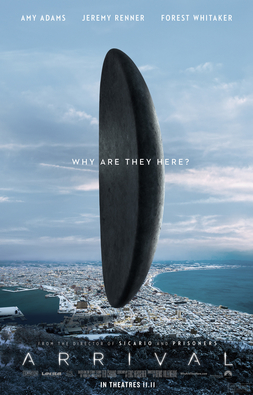
Reasons to see (or not) Arrival
Synopsys: One day, out of the blue, 12 alien ships appear on our planet at random locations. The only action such aliens are taking is opening their ship, letting us in, and burp at us for an hour or so. The US army thinks that an expert linguist able to speak nearly every language can translate the burps for them just by listening to a tape. The US army is not particularly bright. The linguist is then allowed to go inside one of the ships where she starts working on their language.
Arrival is a Sci-Fi movie that very often will remind you of other Sci-Fi movies but somehow manage to maintain its own identity. The fans of the genre will enjoy both the references and the peculiarities of the film. Everyone else will enjoy a reasonably original product, given that you can't demand scientific accuracy from such a movie.
As usual, I will try to give you as many elements as possible to decide if the movie is worth seeing by remaining spoiler-free. Part of the discussion can't avoid spoilers and will be placed safely after the picture.
The dominant theme of the movie is the importance of communication and, more generally, of making the effort of understanding each other. The aliens make their appearance in a pacific fashion and immediately show that they want to talk. This defuses our aggressiveness and we start making the effort of understanding each other.
Nearly the entire movie is centered around the main character (Amy Adams), a linguist, and her attempts to understand their language in order to be able, one day, to ask them what is the purpose of your trip?
So, in short, it's a movie on how to become an intergalactic airport security guard.
The plot proceeds on this theme until, as we see in the trailer, things go sideways because we see them saying the word weapon and we just go bananas about it. In this intense part of the film, the other big theme takes over. It is true that, since the aliens appeared all over the planet, the various governments are cooperating. However, as one may expect, there is no full information disclosure and this lack of trust is leading to a global war.
More about these themes will be written in the spoiler section (after the picture)
Looking at the movie as a cinematographical product, it is globally well executed. The various arcs of tension are well displayed and it is not difficult to follow the plot. However, I should admit that going out of the theater I had the feeling that the movie was longer than 2 hours. It can thus look slightly slower than it should be mostly because, more sooner than later, the viewer figures out where it is going.
The actors' performances are convincing but I've perceived a couple of weaknesses. The first is the Academy Award winner Forest Whitaker, whose presence was pumped during the promotion of the film, because he has a very marginal role with, occasionally, very stupid lines. In other words, I was expecting more from him.
The second dark spot on the movie are the mentioned stupid lines. In a generally solid screenplay with peaks of deep dialogues, the tone is occasionally disrupted by very silly lines thrown from now and then. Someone in the theater will find them funny but it will be the same someone that laughs at the Nespresso's commercial.
In conclusion, it is a movie worth seeing with a good set of themes (some of them discussed above, others in the spoiler section) that may let you think about them for a bit when you leave the theater. I personally had the same feeling I had right after 1997 movie Contact, another product with some sloppy aspects that made it slow. To be more specific, I had the feeling that the book (because both movies are inspired by a book) would be a very nice read. With Contact I was right since it is not a masterpiece but rather a cornerstone of the genre. Maybe Stories of your Life, the book that inspired Arrival, will give a similar emotion.
I give you one more line to not accidental read what is next, from now onwards: Spoiler Alert.
The big theme that hits you once that you figure it out the main twist (and this happens fairly soon) is the value, even the existence, of free will. I actually enjoy this kind of pointless discussions, so here we go.
Essentially the aliens came to Earth to teach us their language because, as poorly explained in the movie, this knowledge will completely change our perception of time. In particular, we see how the main character is affected by that: she starts to remember the future. This not only destroys any concept of entropy that we currently have, but essentially reduce the future to a self-fulfilling prophecy. She saves the world by using a knowledge that she can acquire in a future where she saved the world in that specific way.
At the same time, she accepts her future, the birth of a child that will die too young, without making any effort to change it. Essentially, she is living her entire life, any single moment of it, at the same time. However, since she is not trying to change anything, she gives up any control on it, being a simple passenger of her own existence.
The movie addresses it as a gift (knowing there will be an end will make me appreciate every moment more), I just find such existence very sad and pointless for her. However, such knowledge apparently brought humankind to a fully cooperating, peaceful existence, suggesting that knowing how bad is going to end will stop us to screw it up. As if it ever worked before.
The main reason why I've enjoyed the film is that it made me think about this. On the other hand, in addressing its brightest spot, the movie falls short in motivating itself. This is the other reason why it reminded me of Contact. Also there we had aliens coming to us to give us their technology and also there the movie felt short in motivate such choice (the book did very well though). Since the question is essentially Why is this movie happening? I think that addressing it with the appropriate attention would have made it a very good product.
Thursday, October 13, 2016
Netflix finally missing a shot: Marvel's Luke Cage
It was thus a big surprise when I finished Marvel's Luke Cage: it is not at the level of the other two. Not even close. I will try to explain why and remain spoiler-free.
Luke Cage was introduced in the Netflix universe during the first season of Jessica Jones. He is a bartender somehow connected to the recent past of Jessica and it turns out he has superpowers: his skin is indestructible and he is superstrong. Here, we find him in Harlem a few months after the events of Jessica Jones, living a quiet anonymous life.
The season is essentially an origin story: the events will make Luke Cage take action against the evil villain, forcing him to face his obscure past and finally move forward. Always. I will say no more to let you discover it by yourself.
The first issue is the most problematic one and is about the hero himself. I have the same issue with Superman: any challenge is futile until kryptonite appears. For Luke Cage is even worse since there is no kryptonite for him. The immediate consequence is that any action scene loses its tension and they are not choreographically good as in other shows. Why dodge a bullet if it bounces on you? I can save a few of them because we can all like a power player from time to time but, in general, they are very underwhelming.
Luke Cage's kryptonite is really only his past and his consciousness. This is well displayed in the show, but I never felt tension when his fate was on the line. If you have an invulnerable character you need to give him some sort of deepness, some moral purpose, something other than the usual call for justice and revenge we are used to seeing. We thus have to look how the character and the story are presented.
Most of these guys wear spandex, who would have thought that a black man in a hoodie would be a hero
The entire story takes place in Harlem, therefore we have glimpses of Harlem's culture and how the characters are participating in such culture, what is their role. When it comes to Luke Cage, we can appreciate an attempt to give him some political weight by making him expressing some opinions on the role of the community. In particular, it comes to my mind a very intense monolog on Crispus Attucks and the use of the N-word. However, such attempts are quickly lost after the first few episodes, leaving the picture incomplete and thus failing in drawing a character that creates tension or emotions. The collateral effect is representing a community through powerful messages and then fall in the most generic silliness. Allow me a very insignificant spoiler: a black kid is beaten up by the police during an interrogation and the community, after like 5 minutes of rage, responds by giving the police better guns. That's generic silliness.
Another big issue is the presence of too many villains in one season. In a superhero show, the villain is 80% of the final result because what makes the story interesting is the struggle, how the superhero overcomes the adverse conditions and defeats the villain. In Luke Cage, there is a potentially great villain that is then wasted, lost and obscured by other breaking into the scene, villains way less interesting and way over the top.
The storyline is then confused because force the viewer to shift the attention to different menaces.
There is this villain!
Forget about that, now there is this one!
What's up, guys? I am another one, watch me!
The result is either a very non-linear narration or a very slow one, needing half of the season to even begin.
One last remark about the crossover technique, which was one of the strong suits of Jessica Jones. If the viewer was able to appreciate everything of the last year's show without knowing the rest of the Marvel universe, this time I feel like you actually lose something. You don't get the reasons why some character acts in a certain way. Therefore I feel one of the revolutionary aspects introduced by Netflix one year ago as lost in favor of a more conventional marketing strategy.
In conclusion, it is a show that brings some fun, the technical execution is at the level of the others, but fails in being innovative as it could be. A not so well characterized superhero, a not convincing narration structure, and the feeling that the only reason of its existence is a set up of what is coming next year on Netflix all make the show a forgettable one and several steps behind the previous two.
Tuesday, October 11, 2016
The fall of the titan: Mr. Robot
I also have to admit that I am writing these lines with the spirit of a betrayed lover. Therefore, to explain my feelings, I have to justify both the love and the betrayal.
The love was coming from season 1. I am not afraid to say that Mr. Robot (with Sense8 a close second) was the best show of the past year for the concept, the message and, most of all, the execution. The structure of the narration was nearly perfect, moving the plot at every given episode without wasting any time: every single storyline matters in the big picture of the full season. I can spend many words on the convincing acting or the amazing camera work, or on how much I loved the soundtrack (and how they brutally interrupt it to let a scene suddenly begin). The psychological drama was in a sense hidden in the frame of the plot before revealing itself in that eighth episode and then explode in the amazing next one.
You knew it all along, didn't you?
It is thus clear that living up to that level is difficult for any show. If you try to look at it with a cold heart, you will notice that you have enjoyed a show that is basically a montage of different movies. The high skill of the creators was lying precisely in feeding us something that we knew all along and yet entirely different and exciting. For this reason, I look at the first season as a miracle of TV Shows.
However, considering my high expectations, season 2 turned out to be such a mess on almost every good aspect of the previous one. I can't help to consider this a betrayal.
First of all, the season suffers from a problem sadly common to many many movie sequels/prequels: a good part of it is dedicated to explaining the previous season. Such explanations, like the episode that opens up with a flashback to the moment when they decided to do the hack, do not add anything to the story and, therefore, have no reason to be there. In a season that, as we will see in a moment, has to explore so many storylines, adding unnecessary details to something that already happened makes the narration cumbersome and confusing.
It appears clear that the plots to be explored are 4:
- How they follow up the attack
- How they escape to the FBI
- What the Dark Army and WhiteRose have in mind
- What's the next move of the E-Corp
These were the plots to be developed and to some extent they were. My problem is in those useless flashbacks and in what surrounds them. One plot above all: Joanna, Tyrell Wellick's wife. At the beginning of the season, she is covering something up about the hack by paying and then killing (s02e05) the guy that woke up Elliot at the end of the previous season (s01e10). Then she is struggling to maintain a clandestine relationship with the boring but beautiful guy that punches like a little girl. Her continuous presence on screen is not justified by the events, I waited and waited to see if she got eventually relevant, but no. She receives calls for the entire season, that would be interesting if they were coming from Tyrell; except they were coming from another insignificant character! Her presence just slows down the stories and it is, in the big picture, irrelevant.
One may argue that it will be relevant in the next season so they, so to speak, kept her character warm for the viewers. But this is a betrayal of the first season's approach where nothing was there only to set up a sequel.
Another element of confusion is the character of Angela. She is popping out everywhere in the story, in every subplot. She does everything, she even knows how to contact Tyrell and even WhiteRose is surprised of her. Her character takes so many spins and turns along the season to lose any identity: she is just what is needed to move the plot along, the Angela ex machina.
We can all agree that the opening is very dense of plots to be wrapped together, reminders of what happened a year ago, and Elliot descending to madness. Thus I now justify the difficulties that brought Sam Esmail to apologize on twitter. However, after episode 5, the narration is confusing, jumping from character to character without a specific logic. Sometimes the authors interrupt one plot for 1 or even 2 episodes, moving our attention somewhere else. This can be a strategy to transmit the chaotic state of mind of the protagonist, but the effect is rather making the viewer less involved in what was happening on the screen.
One may argue that it will be relevant in the next season so they, so to speak, kept her character warm for the viewers. But this is a betrayal of the first season's approach where nothing was there only to set up a sequel.
Another element of confusion is the character of Angela. She is popping out everywhere in the story, in every subplot. She does everything, she even knows how to contact Tyrell and even WhiteRose is surprised of her. Her character takes so many spins and turns along the season to lose any identity: she is just what is needed to move the plot along, the Angela ex machina.
Control can sometimes be an illusion, but sometimes you need illusion to gain control.The first episodes were mostly dedicated to exploring the psychological drama of the main character, Elliot. This was done perfectly, with him fighting his alter ego and then understanding how to live with it (except falling in another illusion of control). I started to appreciate that only during my second viewing, especially once that I was sure what was the end of the mentioned illusion. It is precisely this difficulty in being involved in this new season that made me focus on another sloppy aspect of the show.
We can all agree that the opening is very dense of plots to be wrapped together, reminders of what happened a year ago, and Elliot descending to madness. Thus I now justify the difficulties that brought Sam Esmail to apologize on twitter. However, after episode 5, the narration is confusing, jumping from character to character without a specific logic. Sometimes the authors interrupt one plot for 1 or even 2 episodes, moving our attention somewhere else. This can be a strategy to transmit the chaotic state of mind of the protagonist, but the effect is rather making the viewer less involved in what was happening on the screen.
I could surely mention a few great scenes or even great episodes, from now and then. I surely appreciated the bold experiment of episode 6, where Elliot finds himself living in an illusory world based on the Tv Show Alf, a situation heavily recalling a scene from Oliver Stone's Natural Born Killers that is one of my favorite movies. But if I have to evaluate the season in its entirety, Mr. Robot falls short even if I do not consider my high expectations.
You realize that the episodes that effectively develop the plots listed above are less than 5. In a 12 episodes season long, this is a failure at the level of Game of Thrones. The powerfulness of the show was to create a cluster of episodes where everything ultimately mattered and contributed to the final result. The plot was interesting and loaded with complexity by itself, the narration was then direct because further complications weren't needed. Here we just have another show trying to drown itself in the storytelling. The complexity is now coming from a cumbersome narration rather than from the plot itself.
The entire post could have been shorter, containing the single thoughts that surprised me at the end of season 2: I didn't want to find out immediately what happens next. This is how bad it was. And we can only feel sorry about that because we have probably lost a gem.
Subscribe to:
Posts (Atom)